
The CommerceHub integration built for every retailer you add.
DropStream connects CommerceHub’s OrderStream and Dsco to the warehouse or 3PL that ships your dropship orders. Merchants and 3PLs add retailers without building EDI, and every retailer ships the same way.
A CommerceHub integration you can count on.
CommerceHub is how big-box retailers send you their dropship orders, and how they measure you. When a ship confirmation reaches CommerceHub late or incomplete, an order that left on time is flagged late, and the retailer can charge it back. DropStream keeps your warehouse’s answer flowing back for every retailer you add, backed by 15+ years.

99.98% platform uptime
Live every day of the year, with no blackout periods.

ISO 27001 certified
Role-based access, audit trails, and encryption for your retailer order data.

15+ years, founder owned
Privately owned since 2010. Loyal to customers, not investors.

Ship confirmations that land
Each line posts back to CommerceHub as the warehouse ships, and failures alert you.
Connect CommerceHub once. Ship every retailer from any warehouse.
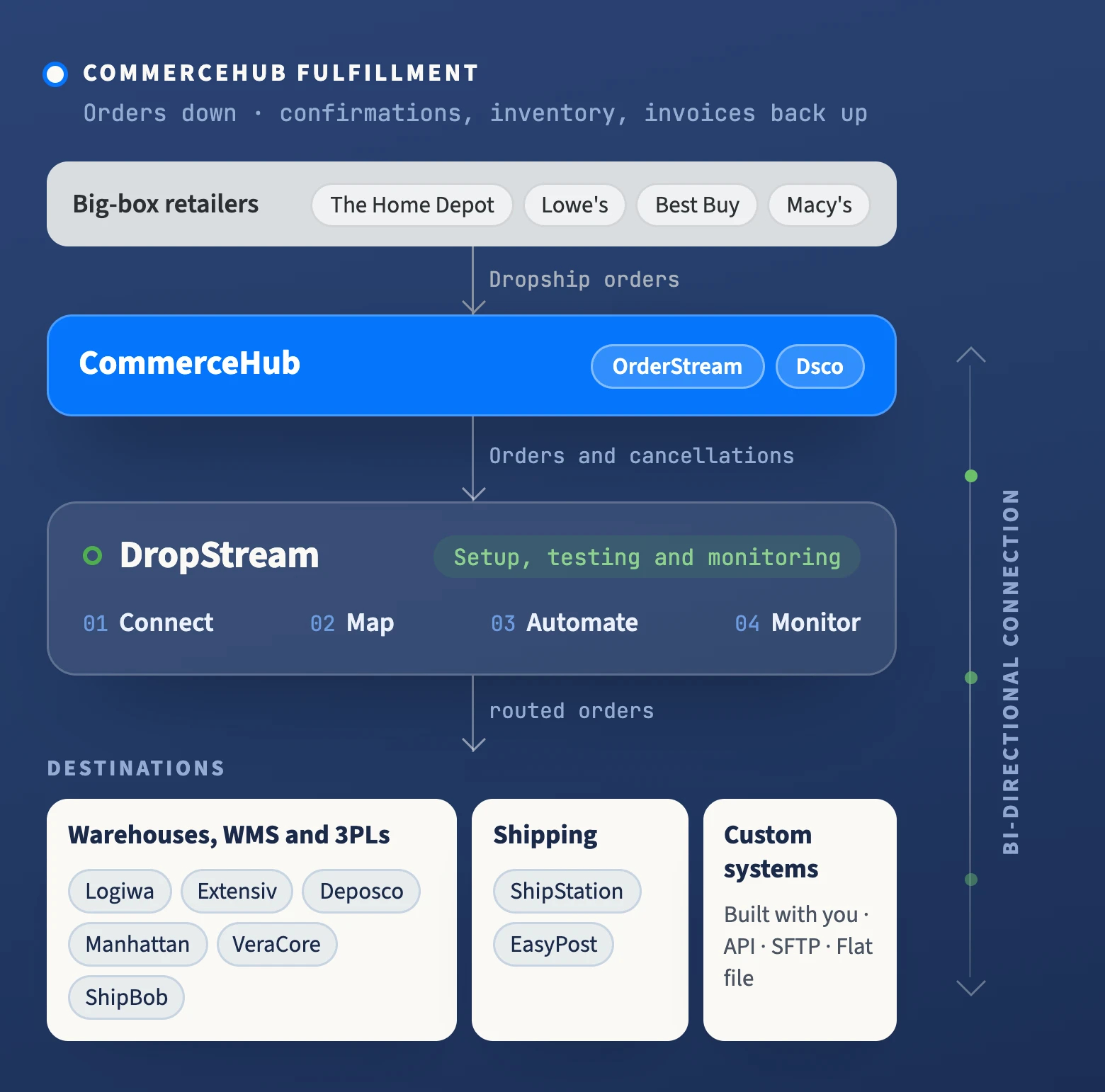
CommerceHub fulfillment runs through two hands. CommerceHub brings the retailer’s order, and your warehouse or 3PL ships it. DropStream connects them both ways: orders reach the WMS mapped by SKU, and whatever your warehouse records gets back to CommerceHub.
What CommerceHub connects to:
- Retailers via CommerceHub: Dropship orders from big-box retailers arrive from OrderStream or Dsco (both now part of Rithum), whichever platform each retailer uses. CommerceHub is one of the EDI platforms we connect.
- Warehouses and 3PLs: Orders go to the WMS or 3PL that ships them. Confirmations, tracking, inventory, cancellations, and invoices go back to CommerceHub.
- Shipping platforms: Ship from your own warehouse? Orders go to ShipStation or EasyPost for labels, and tracking returns to CommerceHub.
- Custom systems: No pre-built connector for a system you run? We build a custom integration with you, in weeks, not quarters.
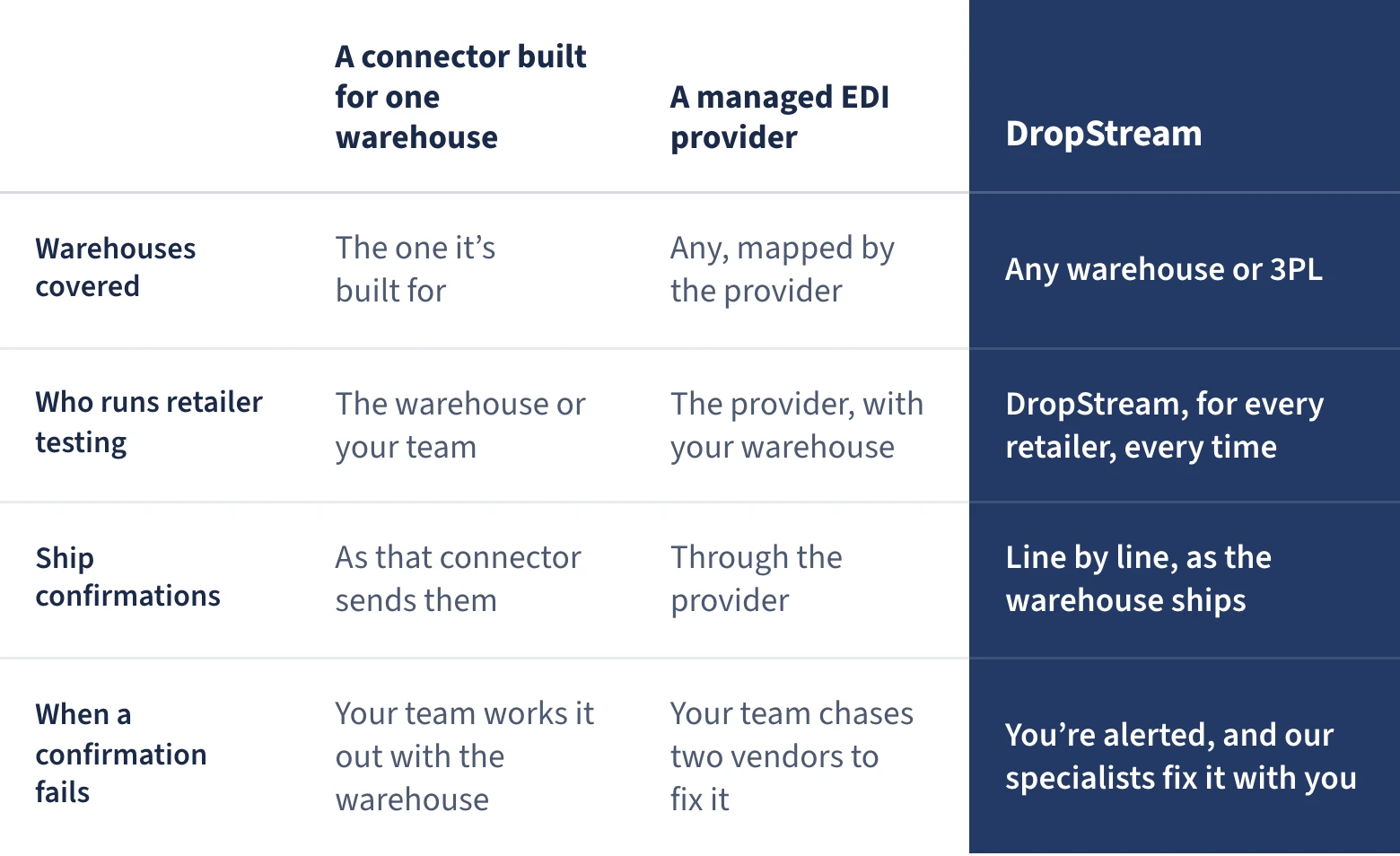
Three ways to answer CommerceHub. One runs the testing for you.
Every CommerceHub fulfillment integration has one job: get the warehouse’s answer back to each retailer. Here is how the options compare.
A connector built for one warehouse.
The upside: it comes with the warehouse, or it’s yours to run.
The catch: it covers one warehouse, so a new one means a new CommerceHub setup.
A managed EDI provider.
The upside: someone else maps the documents.
The catch: a second vendor in the middle, so a late confirmation is two vendors to trace.
DropStream.
The upside: any warehouse, with setup and every retailer’s test cases run by us.
Best fit when: you add retailers or fulfill for several merchants.
Two sides of CommerceHub. One answer back to every retailer.
You win the retailer. We get your warehouse’s answer back.
Big-box retailers send your dropship orders through CommerceHub. DropStream connects them to your warehouse or CommerceHub order fulfillment provider and sends every update back.
- Stock retailers can trust. Inventory goes to CommerceHub on the schedule you set, so retailers sell what you have on hand.
- Confirmations, line by line. Each shipped line posts back with tracking and carrier, partial shipments included.
- OrderStream or Dsco. Whichever CommerceHub platform a retailer uses, your orders reach the warehouse the same way.
You win the merchant. We run the retailer testing.
Your new merchant sells to big-box retailers through CommerceHub. DropStream connects it to your WMS, so 3PL fulfillment for CommerceHub never turns into an EDI build.
- Test cases, handled. CommerceHub validates every merchant with every retailer, and our team runs that testing each time.
- Whatever your WMS records. Confirmations, tracking, inventory, cancellations, and invoices reach CommerceHub as your WMS captures them.
- Every merchant monitored. DropStream watches each connection and alerts your team when a confirmation fails.
Scoping is free. Testing is ours.
Every CommerceHub setup includes retailer testing. Our specialists run it with you, start to finish.
It starts with free technical scoping. CommerceHub sets up the retailer, and our specialists handle the rest with your warehouse: setup, mapping, and the test cases CommerceHub requires, all before go-live.
When you add a retailer, we run its test cases again, so it never lands on your team alone. After launch, you reach the same specialists, not a ticket queue.
Founder-led since 2010 and privately owned, DropStream answers to the merchants and 3PLs it works with, not to investors.

"It’s comforting to know that DropStream is reliable. It just works. It’s been a great asset over the years that adds value to what we offer."

Keep CommerceHub and your whole stack in sync.
Free technical scoping · Weeks, not quarters · 99.98% uptime